
A clearer path from load to invoice

AI accounting automation for trucking companies

Trucking accounting is document-heavy and deadline-heavy: rate cons, BOLs, PODs, fuel, tolls, detention, settlements, factoring and collections, every week, for every load. We automate the extraction, matching and chasing so the books close faster and pay day has no surprises.

Your software project · 1 / 3

What should we automate first?

Select everything that applies.

Free call · no obligation

Built from real trucking experience. Some of the companies CDL Agency works with.

The problem

The books are slow because the paperwork is manual.

Invoicing waits for the POD. The POD waits for the driver. Settlements wait for someone to match loads to deductions. Collections wait until someone has time to look at the aging report. Every wait is cash sitting outside the company.

Accounting software is good at the ledger. It is not good at reading a crumpled BOL from a phone photo or knowing that a driver’s lease-on deductions changed last month. That gap is where we work.

What we automate

Before and after, job by job.

01

Rate con to invoice

Before: the rate con is read by a person and typed into the TMS and the invoice. After: the fields are extracted, matched to the load, and the invoice is drafted the moment the POD arrives.

02

POD collection

Before: billing chases drivers for PODs. After: the driver photographs it, the agent reads it, checks it against the load and files it. Billing sees only the missing ones.

03

Settlement pre-check

Before: pay disputes on pay day. After: every settlement is checked against loads, advances, fuel and deductions before release, and exceptions go to a person with the evidence attached.

04

Detention and accessorials

Before: detention is billed when someone notices. After: ELD and TMS timestamps are compared on every load, and billable detention is documented and added before the invoice goes out.

05

Factoring and AR

Before: uploads and follow-ups are a weekly chore. After: invoices are submitted on schedule, the aging report is read daily, and reminders go out in your tone with a person stepping in when a customer replies.

06

Owner finance brief

Before: numbers at month end. After: revenue per truck, cost per mile, unbilled loads and overdue AR every Monday, with the loads behind each number one click away.

What we’ve built

Software running in trucking today

Platforms we designed, built and still run for our own operation and our clients.

01Yard software
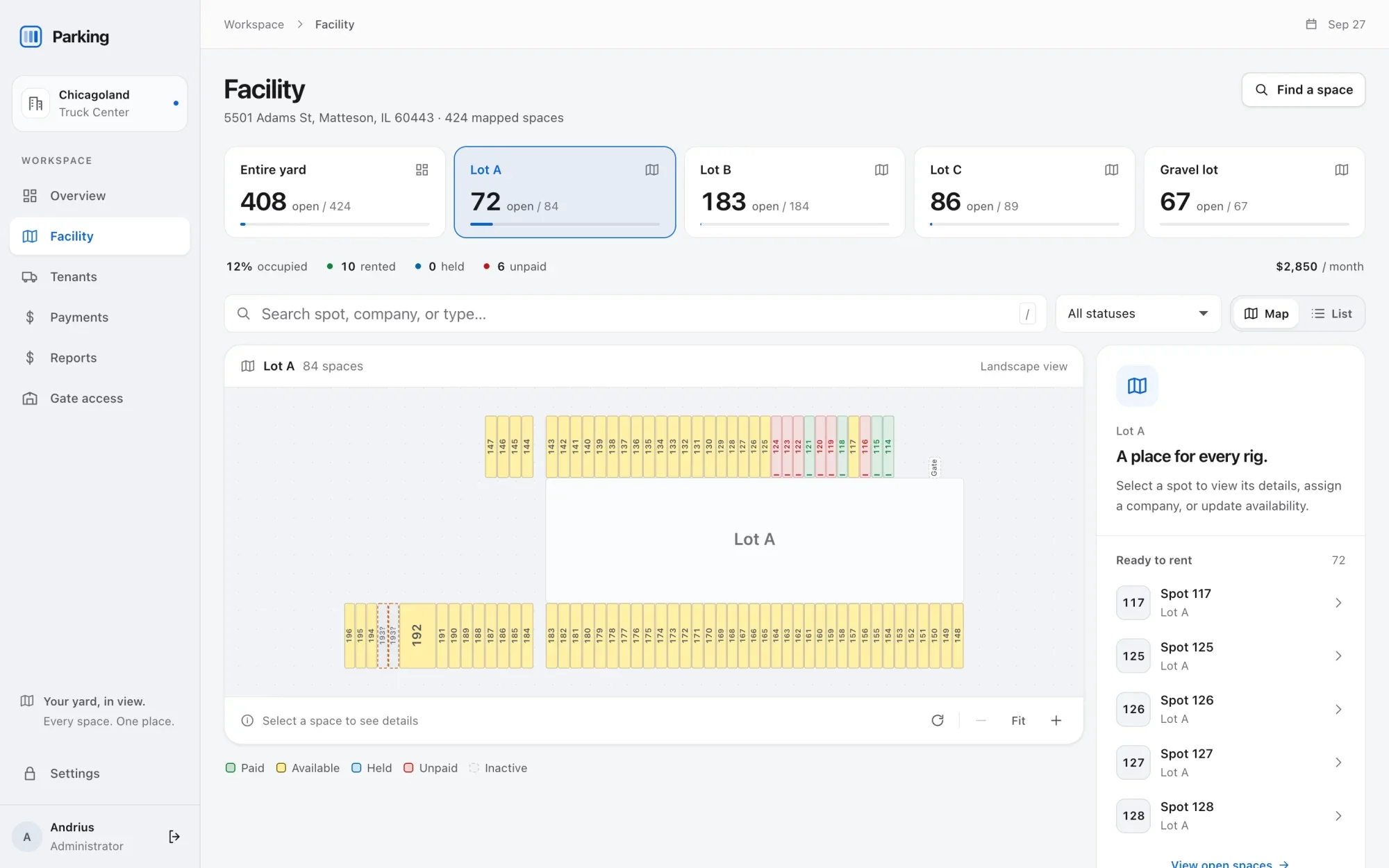
Color-coded yard map of Lot A — demo data
Product screen · demonstration data

Back-office software for a truck parking yard

Yard software for Chicagoland Truck Center

Built for and run by Chicagoland Truck Center's office staff.

The yard's office runs from one screen: a live map of every spot, a file for every tenant company, and a ledger that tracks what each one owes. Rent roll and aging reports export straight to Excel, PDF or CSV.

  • Color-coded yard map — available, paid and unpaid spots at a glance
  • Tenant files with MC/DOT numbers, contacts, agreements and IDs
  • Spot assignment by vehicle type, with every move logged
  • Invoices, receipts, partial payments and credits, with PDF invoices
  • Rent roll, rent paid and aging A/R reports to Excel, PDF or CSV
  • Gate phone-number queue and staff roles
Explore the yard case study

How we get there

An engineer in your corner.
A plan on your desk.

Start with a conversation
  1. 01

    Have the conversation

    Thirty minutes with you and a department lead. Show us the systems, the repetitive work and the questions you can’t answer.

  2. 02

    Get a written map

    We identify the bottlenecks, measure the baseline and put the opportunities in order. The map is yours to keep.

  3. 03

    Build it with your team

    An engineer works inside your existing tools. Your people review the workflow and test it before it takes action.

  4. 04

    Measure. Learn. Improve.

    We review the numbers together, train your team and decide what to tackle next. One useful workflow at a time.

Engagement

Faster invoicing is the most visible early win.

Days-to-invoice and unbilled detention are two numbers we can measure on day one and move within weeks. They are usually in phase one for exactly that reason.

Nothing is sent to a customer or paid to a driver without an approval step until the agent’s accuracy is proven on your own data.

We are not your accountant

We automate the flow of documents and data into and around your accounting system. Your bookkeeper or CPA still owns the books, the tax positions and the judgment calls. What changes is that they receive clean, matched, timely data instead of a shoebox.

If you use QuickBooks, a trucking-specific accounting package or a payroll provider, we connect to it. Replacing it is not part of the plan unless you want it to be.

What “80% of accounting time back” means

It is the target for the administrative share of the accounting desk’s week: extracting, typing, matching, uploading and chasing. We measure that share in the audit and report against it weekly. The judgment work stays with your people.

We do not publish a savings figure for your company before measuring your baseline.

FAQs

Accounting Automation questions?
Find answers.

Have more questions? Reach out or book the audit.

QuickBooks Online and Desktop, trucking accounting packages with an API or export, and payroll providers such as ADP and Gusto. Factoring portals vary; where there is no API, the agent prepares the upload and a person submits it.

Usually yes for the fields that matter: dates, signatures present, piece counts and reference numbers. Every field has a confidence score and anything uncertain goes to a person. Accuracy improves as the agent sees your customers’ paperwork.

The settlement pre-check catches most of them before pay day. When a driver still disputes, the agent assembles the loads, deductions and documents behind the settlement so the conversation takes minutes instead of an afternoon.

Yes. The finance brief and the dashboards are built for the owner first. Every number links to the loads, invoices or settlements behind it.

It lives in your private tenant with role-based access and full logging. We sign a data processing agreement and your data is not used to train shared models.

A good place to start

Let’s make room for the work that matters.

Bring the process that slows you down. We’ll map the opportunity, talk through what’s practical, and give you a clear next step.