
Agents that do the work

AI agents for the trucking industry that do the work, not just answer

A chatbot answers a question. An agent reads the ELD, texts the driver, collects the med card, files it, updates the safety log and tells the safety manager it is done. We build agents for the jobs your office repeats every day, and every one of them reports what it did.

Your software project · 1 / 3

What should we automate first?

Select everything that applies.

Free call · no obligation

Built from real trucking experience. Some of the companies CDL Agency works with.

The problem

The repetitive work is the expensive work.

Most of what a trucking back office does is the same ten jobs, every day: check calls, document chasing, data entry between systems, answering the same driver questions, matching paper to payments and assembling the Monday report. The people doing it are good. The jobs are just not good uses of them.

Generic AI tools do not help because they do not know what an MVR is, what a rate con looks like or why a lease-on driver’s settlement is different. Agents only work when they are built around your records and your rules.

What we automate

Before and after, job by job.

01

Driver questions agent

Before: dispatch answers “when do I get paid?” forty times a week, including at 2 AM. After: an agent answers from the driver’s own settlement data by text or phone, and escalates the real problems to a person.

02

Document chase agent

Before: safety emails and calls drivers about expiring documents for weeks. After: the agent texts, collects the photo, reads it, files it and escalates only the ones that ignore it.

03

Check-call agent

Before: dispatchers call every driver for a status. After: drivers text a status or the ELD location is read, the TMS updates itself, and dispatch sees only the exceptions.

04

Recruiting agent

Before: a lead waits hours for a call back. After: every lead is answered in under a minute, qualified against your hiring rules, and booked into orientation. This is the system CDL Agency recruits with.

05

Email triage agent

Before: a shared inbox with 400 unread. After: broker updates, rate cons, carrier packets and invoices are sorted, extracted and routed to the right record and the right person.

06

Settlement check agent

Before: pay disputes surface on pay day. After: every settlement is checked against the loads and deductions before it goes out, and the exceptions get a human.

What we’ve built

Software running in trucking today

Platforms we designed, built and still run for our own operation and our clients.

01Onboard Voice
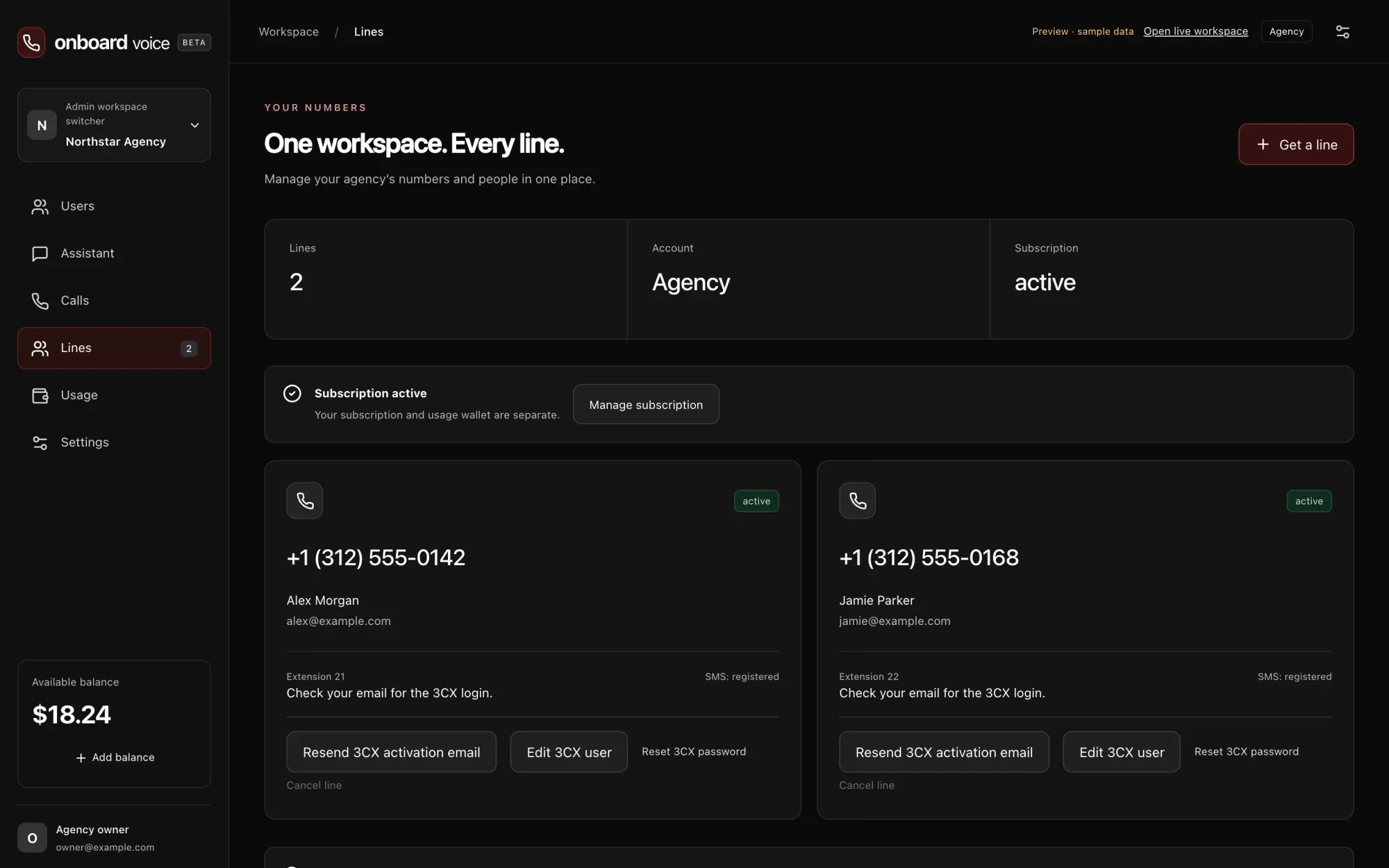
Onboard Voice — every line in the workspace — demo data
Product screen · demonstration data

Business phone lines for recruiters and agencies

Onboard Voice

Runs CDL Agency's recruiting phone lines, and is being opened up to partner recruiters.

A recruiter picks a real local number, and the line is set up on a proper business phone system automatically. Agencies manage their team's lines, invites and billing from one workspace — no calls to a phone company, no shared personal cell numbers.

  • Pick a real local number by area code
  • Lines set up on a 3CX business phone system automatically
  • Solo and agency workspaces with team invites
  • Suspend, restore or reset a line's access from one screen
  • Subscription billing and a prepaid usage wallet (Stripe)
  • One directory of every line and extension across providers
Explore Onboard Voice

How we get there

An engineer in your corner.
A plan on your desk.

Start with a conversation
  1. 01

    Have the conversation

    Thirty minutes with you and a department lead. Show us the systems, the repetitive work and the questions you can’t answer.

  2. 02

    Get a written map

    We identify the bottlenecks, measure the baseline and put the opportunities in order. The map is yours to keep.

  3. 03

    Build it with your team

    An engineer works inside your existing tools. Your people review the workflow and test it before it takes action.

  4. 04

    Measure. Learn. Improve.

    We review the numbers together, train your team and decide what to tackle next. One useful workflow at a time.

Engagement

Two agents in the first six weeks.

The audit ranks every agent by dollars and by how fast we can measure it. Phase one is two agents, chosen so one is felt by the operations director in week one and one shows a number at the 90-day review.

Every agent ships with an eval set, a kill switch, full logging and a human-review period before it acts on its own. Anything that sends a message or touches money fails closed.

How we keep agents safe in a trucking operation

An agent that texts a driver the wrong orientation date, or fires a dispatch alert twice at 3 AM, costs you trust that takes months to earn back. So every agent runs in shadow mode first: it drafts, a person approves, and we measure how often the human changes anything. Only when that number is near zero does it act alone, and only inside the limits you set.

Everything it does is logged against the record it touched. If a driver says “your system told me X”, you can see exactly what it said and why.

Built on your company memory

Agents are only as good as what they can see. Ours read from the company memory we build first, so the recruiting agent knows which carriers are hiring this week, the settlement agent knows the driver’s lease terms, and the document agent knows the safety manager is out on Friday.

This is also why the second and third agents cost less than the first. The plumbing is already there.

FAQs

AI Agents questions?
Find answers.

Have more questions? Reach out or book the audit.

A chatbot answers a question in a chat window. An agent has tools: it can read your systems, send a text or an email, update a record and hand off to a person. We build agents, and we only give them the tools the job needs.

Yes. Every agent identifies itself when asked and makes it easy to reach a person. In our experience drivers prefer an instant, correct answer at 11 PM over a callback the next morning.

We pick the model per task. Frontier models from Anthropic, OpenAI and Google for reasoning and reading documents, smaller or local models where speed and cost matter more. Your data stays in your tenant regardless of model.

It is logged, the person it escalated to fixes the outcome, and the case goes into the eval set so it is tested on every future change. Agents that send messages or move money run behind an approval step until their accuracy is proven.

Agents are built under the weekly retainer and run on a monthly maintenance plan per live agent that covers hosting, model costs, monitoring and updates when your systems change. Pricing is on the pricing page and confirmed on the audit call.

A good place to start

Let’s make room for the work that matters.

Bring the process that slows you down. We’ll map the opportunity, talk through what’s practical, and give you a clear next step.