
More output per employee

Automate your trucking back office with AI

The back office of a 100-truck carrier is a dozen people moving information between systems that do not talk to each other. We automate the moving: the re-typing, the chasing, the sorting and the follow-ups. Your people keep the judgment calls.

Your software project · 1 / 3

What should we automate first?

Select everything that applies.

Free call · no obligation

Built from real trucking experience. Some of the companies CDL Agency works with.

The problem

Every department re-types the same thing.

A driver’s information is typed into the ATS, then the TMS, then payroll, then the ELD, then the insurance portal. A load’s details go from the rate con into the TMS, then the invoice, then the factoring upload. Each step is an opportunity for a typo, a delay and a person who could be doing something else.

Adding headcount scales the problem, not the solution. The office that runs 100 trucks with eight people and the one that runs them with fourteen are usually separated by automation, not effort.

What we automate

Before and after, job by job.

01

Data entry between systems

Before: the same driver or load is typed into four systems. After: it is entered once and synced everywhere, with a log of what changed where.

02

Document reading

Before: someone opens the PDF and types the fields. After: CDLs, med cards, MVRs, rate cons, BOLs and PODs are read by AI and the fields land in the record. A person checks only the low-confidence ones.

03

Driver onboarding packets

Before: a stack of forms, chased over email. After: packets are generated from the record, e-signed from a phone, and the file is complete before orientation. Built and running in our Onboard platform.

04

Shared inbox triage

Before: three people read the same inbox. After: every message is classified, extracted and routed to the right record and person, with a draft reply where one is routine.

05

Follow-ups that never drop

Before: “I’ll follow up Friday” is a sticky note. After: every open item has an owner and a date, and the system follows up by text or email until it is closed.

06

Owner’s daily brief

Before: the owner asks three people what happened yesterday. After: one morning message with what moved, what is stuck and what needs a decision.

What we’ve built

Software running in trucking today

Platforms we designed, built and still run for our own operation and our clients.

01Onboard
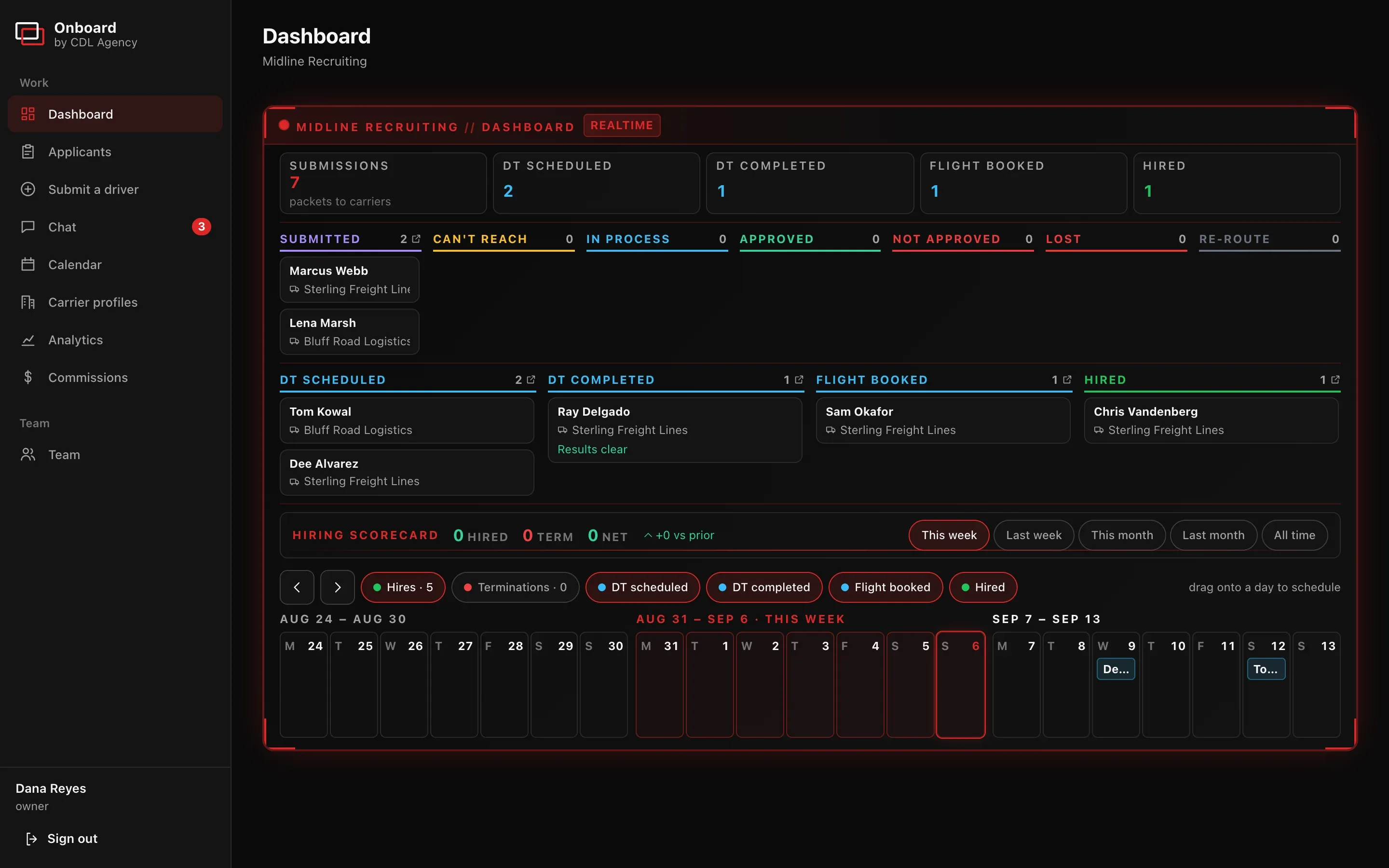
Onboard recruiter dashboard — demo data
Product screen · demonstration data

Driver placement platform for recruiting agencies and carriers

Onboard

Runs CDL Agency's driver submissions and partner agencies' placements.

Recruiters upload a driver's CDL, the application fills itself in, and a submission packet goes to the carrier. The carrier approves, declines or confirms the hire from a secure link, and every placement lands in a commission ledger that pays out by retention milestone.

  • AI reads the driver's CDL photo or PDF and fills in the application
  • Submission packets sent to carriers in one step
  • Carriers approve, decline or confirm a hire from a secure link — no login
  • Shared pipeline, calendar and carrier chat
  • Commission ledger with installments paid per retention milestone
  • Partner invitations with e-signed agreements
Explore Onboard

How we get there

An engineer in your corner.
A plan on your desk.

Start with a conversation
  1. 01

    Have the conversation

    Thirty minutes with you and a department lead. Show us the systems, the repetitive work and the questions you can’t answer.

  2. 02

    Get a written map

    We identify the bottlenecks, measure the baseline and put the opportunities in order. The map is yours to keep.

  3. 03

    Build it with your team

    An engineer works inside your existing tools. Your people review the workflow and test it before it takes action.

  4. 04

    Measure. Learn. Improve.

    We review the numbers together, train your team and decide what to tackle next. One useful workflow at a time.

Engagement

We automate the ten jobs your office repeats every day.

The audit measures the hours each repetitive job takes today. The map ranks them by hours saved and by how cleanly we can automate them. The first phase takes the top two.

The goal is simple: the same team handles more trucks, with fewer errors and shorter days.

Where the hours actually go

When we audit a trucking office the pattern repeats. Roughly a third of office time is moving information between systems, a quarter is chasing people for documents and answers, and another chunk is assembling reports by hand. The work that needs human judgment, negotiating, deciding, handling the exception, is a minority of the day.

Automation flips the ratio. The system moves and chases. People decide.

What stays human

Anything with a relationship or a judgment: the conversation with a driver who is about to quit, the customer who wants a rate exception, the decision to terminate. Our agents prepare the context and hand it to a person. They do not make those calls.

We write that line down during the audit so your team knows exactly what is changing and what is not.

FAQs

Back Office Automation questions?
Find answers.

Have more questions? Reach out or book the audit.

No. We automate around the systems you already use and connect them. Replacing a core system is a separate decision and usually a bad reason to start.

It depends on the baseline we measure in the audit. We set a target per job before we build and report against it every week. We do not quote a savings number before we have measured your operation.

In our experience the office does not shrink; it stops hiring to keep up and the same people handle growth. We train your team on every automation and they approve each one before it goes live.

The AI returns a confidence score for every field. Low-confidence fields are routed to a person to confirm, and the corrections improve the next read.

Yes. Roughly half of what we build is standard across carriers and half is specific to how a company runs. The audit separates the two and prices them.

A good place to start

Let’s make room for the work that matters.

Bring the process that slows you down. We’ll map the opportunity, talk through what’s practical, and give you a clear next step.