
Connect everything in one place

Trucking software integrations that connect every system you run on

You already pay for good software. The problem is the gap between the tools: the driver typed into four systems, the load copied from the rate con into the TMS and then into the invoice. We connect them, sync the records both ways, and give every AI agent the full picture.

Your software project · 1 / 3

What should we automate first?

Select everything that applies.

Free call · no obligation

Built from real trucking experience. Some of the companies CDL Agency works with.

The problem

The expensive part is the work between your tools.

Your TMS, ELD, ATS, accounting, payroll, factoring, email and phone system each hold part of the truth. None of them talks to the others out of the box, and the vendor integrations that exist are shallow. So people become the integration, re-typing and re-checking all day.

Every re-type is a delay and a chance for an error. Every un-synced system is a place the AI cannot see.

What we automate

Before and after, job by job.

01

TMS connection

Before: loads, customers and drivers live only in the TMS. After: McLeod, TMW, Truckbase or your TMS syncs to the company memory and back, so agents can read a load and update a status.

02

ELD connection

Before: HOS and location data sit in the ELD portal. After: Samsara, Motive or your ELD feeds hours, events and locations to safety agents and the reporting layer.

03

ATS and recruiting

Before: applicants are copied from Tenstreet or forms into the TMS by hand. After: one driver record from lead to hire to first load, built on what we run at CDL Agency.

04

Accounting and payroll

Before: invoices and settlements are re-keyed. After: QuickBooks, your trucking accounting package and payroll provider receive matched data and send back payment status.

05

Email and phones

Before: conversations leave no trace in the records. After: Google Workspace or Microsoft 365 email and RingCentral, Dialpad or 3CX calls are attached to the driver, customer or load they belong to.

06

Two-way, with a log

Before: a sync breaks silently. After: every write is logged, every failure is visible, and nothing is overwritten without a rule you approved.

What we’ve built

Software running in trucking today

Platforms we designed, built and still run for our own operation and our clients.

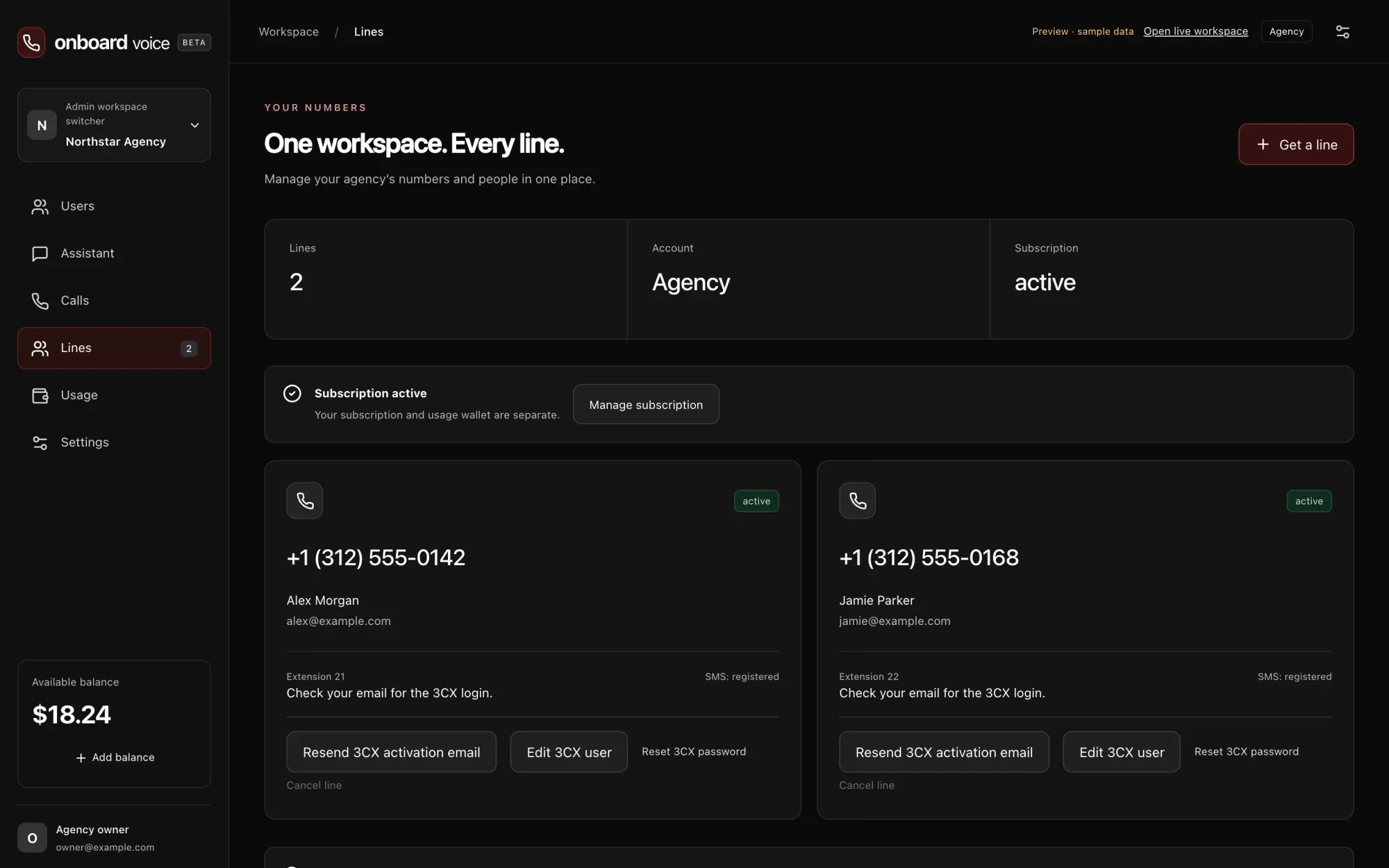
01Onboard Voice
Onboard Voice — every line in the workspace — demo data
Product screen · demonstration data

Business phone lines for recruiters and agencies

Onboard Voice

Runs CDL Agency's recruiting phone lines, and is being opened up to partner recruiters.

A recruiter picks a real local number, and the line is set up on a proper business phone system automatically. Agencies manage their team's lines, invites and billing from one workspace — no calls to a phone company, no shared personal cell numbers.

  • Pick a real local number by area code
  • Lines set up on a 3CX business phone system automatically
  • Solo and agency workspaces with team invites
  • Suspend, restore or reset a line's access from one screen
  • Subscription billing and a prepaid usage wallet (Stripe)
  • One directory of every line and extension across providers
Explore Onboard Voice

How we get there

An engineer in your corner.
A plan on your desk.

Start with a conversation
  1. 01

    Have the conversation

    Thirty minutes with you and a department lead. Show us the systems, the repetitive work and the questions you can’t answer.

  2. 02

    Get a written map

    We identify the bottlenecks, measure the baseline and put the opportunities in order. The map is yours to keep.

  3. 03

    Build it with your team

    An engineer works inside your existing tools. Your people review the workflow and test it before it takes action.

  4. 04

    Measure. Learn. Improve.

    We review the numbers together, train your team and decide what to tackle next. One useful workflow at a time.

Engagement

Integrations are part of every engagement, not a separate project.

We connect what the first agents need in phase one and add systems as the map calls for them. Each connection is confirmed against the vendor’s actual API or export during the audit before we promise it.

Where a vendor has no API, we build around exports and uploads and tell you exactly where a person still has to click.

Why we do not build another TMS

Your TMS is the system of record for loads and it should stay that way. The value is not in replacing it; it is in making it talk to everything else and letting AI work on top of all of it. That is also far cheaper and far less disruptive than a migration.

The same applies to your ELD, your accounting package and your ATS. We connect; we do not rip and replace.

Vendors we have worked with

Phone systems: 3CX, RingCentral, Dialpad and Telnyx, all in production in our own operations. Recruiting: Tenstreet-style ATS flows and our own Onboard platform. Payments: Stripe and Plaid. Email: Google Workspace and Microsoft 365. TMS and ELD connections are confirmed per vendor and per plan during the audit.

If a vendor is not on this list, ask. Most trucking software has an API or an export we can work with.

FAQs

Integrations questions?
Find answers.

Have more questions? Reach out or book the audit.

Sometimes. We check the vendor’s API terms and costs during the audit and include them in the map. If an API is unavailable, scheduled exports usually work for everything except real-time updates.

If it has an API, an export or a database we can reach, yes. We scope it before promising it, and the first integration with a new vendor is built with a longer testing period.

The integration is monitored and alerts us before it alerts you. Fixing vendor changes is covered under the maintenance plan.

No. We read on a schedule or by webhook and write only approved changes. Your systems keep running exactly as they do today.

Ownership, licenses and handover are written into the agreement. Integrations built specifically for you are yours; shared platform components are licensed.

A good place to start

Let’s make room for the work that matters.

Bring the process that slows you down. We’ll map the opportunity, talk through what’s practical, and give you a clear next step.