
Less chasing. More oversight.

AI safety and compliance automation for trucking companies

A safety manager at a 100-truck carrier spends most of the week on administration: chasing documents, checking expirations, running queries, assembling files for an audit. We build agents that do that administration and leave the safety manager to do safety.

Your software project · 1 / 3

What should we automate first?

Select everything that applies.

Free call · no obligation

Built from real trucking experience. Some of the companies CDL Agency works with.

The problem

Compliance is a hundred small deadlines nobody can hold in their head.

Med cards, CDLs, annual MVRs, Clearinghouse queries, annual reviews, road tests, drug and alcohol testing, inspections, violations, training. For every driver. The spreadsheet that tracks it is only as current as the last time someone updated it, and the lapse you miss is the one the auditor finds.

The result is a safety department that is always reacting. The agents below exist so that nothing expires unnoticed and the file is always ready.

What we automate

Before and after, job by job.

01

Expiration monitor

Before: a spreadsheet and a calendar reminder. After: every expiring item is tracked from the source document, the driver is contacted automatically at 60, 30 and 14 days, and the safety manager sees only what is still open.

02

DQ file completeness

Before: files are checked before an audit. After: every driver qualification file is scored for completeness daily, and missing items are chased by the document agent.

03

Clearinghouse and MVR cycle

Before: annual queries are run from a list. After: queries are scheduled per driver, results are read and filed, and flagged results go straight to the safety manager.

04

ELD event digest

Before: HOS violations and harsh events are reviewed when there is time. After: a daily digest per driver with the pattern, not just the event, plus a coaching queue ordered by risk.

05

Incident intake

Before: the driver calls, someone takes notes, the report is written later. After: the driver reports by phone or text to an agent that collects the facts, photos and location and drafts the report for review.

06

Audit-ready in a click

Before: a DOT audit or insurance renewal is a two-week project. After: the evidence for any driver, truck or date range is assembled from the company memory in minutes.

What we’ve built

Software running in trucking today

Platforms we designed, built and still run for our own operation and our clients.

01Onboard
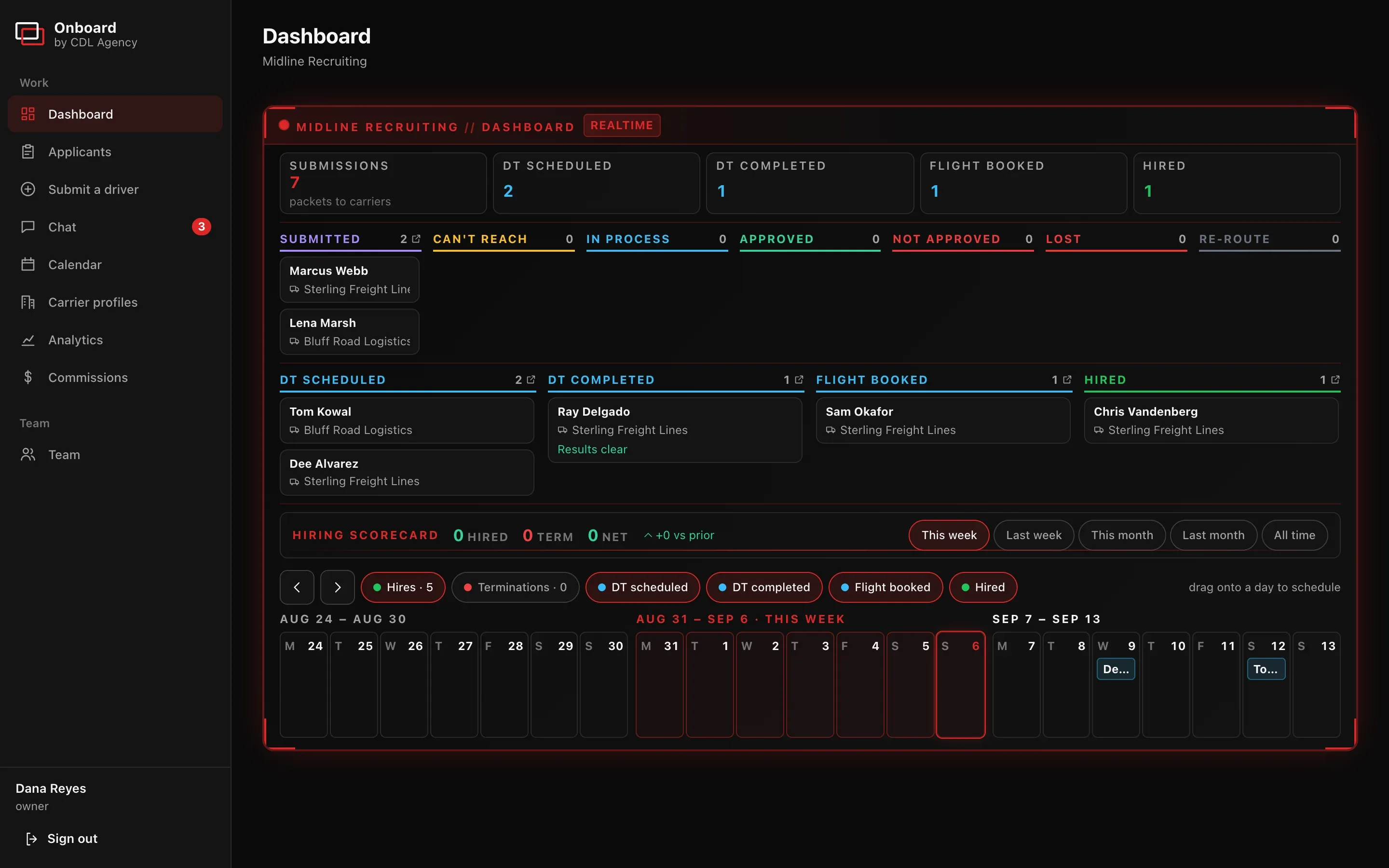
Onboard recruiter dashboard — demo data
Product screen · demonstration data

Driver placement platform for recruiting agencies and carriers

Onboard

Runs CDL Agency's driver submissions and partner agencies' placements.

Recruiters upload a driver's CDL, the application fills itself in, and a submission packet goes to the carrier. The carrier approves, declines or confirms the hire from a secure link, and every placement lands in a commission ledger that pays out by retention milestone.

  • AI reads the driver's CDL photo or PDF and fills in the application
  • Submission packets sent to carriers in one step
  • Carriers approve, decline or confirm a hire from a secure link — no login
  • Shared pipeline, calendar and carrier chat
  • Commission ledger with installments paid per retention milestone
  • Partner invitations with e-signed agreements
Explore Onboard

How we get there

An engineer in your corner.
A plan on your desk.

Start with a conversation
  1. 01

    Have the conversation

    Thirty minutes with you and a department lead. Show us the systems, the repetitive work and the questions you can’t answer.

  2. 02

    Get a written map

    We identify the bottlenecks, measure the baseline and put the opportunities in order. The map is yours to keep.

  3. 03

    Build it with your team

    An engineer works inside your existing tools. Your people review the workflow and test it before it takes action.

  4. 04

    Measure. Learn. Improve.

    We review the numbers together, train your team and decide what to tackle next. One useful workflow at a time.

Engagement

The safety desk is usually the fastest payback.

The deadlines are clear, the documents are standard and the cost of a miss is high. In most audits the expiration monitor and DQ file agent rank in the top three automations by payback.

Every safety agent runs with a person approving its messages for the first weeks, and nothing is filed without a confidence check.

What “80% of safety time back” means

It is the target we set for the administrative share of the safety desk’s week: tracking, chasing, filing, querying and assembling. We measure that share during the audit and report against it. It does not mean fewer safety managers; it means the safety manager spends the week on coaching, inspections and the drivers who need attention.

We do not quote a result for your company until we have measured your baseline.

Working with your existing compliance tools

If you already use a compliance platform, we connect to it rather than replace it. The agents read from it, chase drivers on its behalf and write back what you approve. If your tracking lives in a spreadsheet, the company memory becomes the system of record and the spreadsheet retires.

Either way, the driver only ever gets one message about one document, from one place.

FAQs

Safety & Compliance questions?
Find answers.

Have more questions? Reach out or book the audit.

Yes for the fields that matter: names, dates, license class, endorsements, restrictions and violations. Every field carries a confidence score and anything below the threshold goes to a person. The rules you set decide what the agent is allowed to file on its own.

We schedule and track the query cycle and read the results your designated person downloads or receives. Where the Clearinghouse offers an approved integration path for your account, we use it; where it does not, the agent prepares everything and a person submits.

Samsara, Motive and other platforms with an API. We confirm the exact data available from your ELD during the audit, since plans differ.

No. One message per document, on a schedule you approve, from one number, with a person reachable by replying. The agent stops the moment the document arrives.

No. We build the automation; your safety manager remains responsible for compliance decisions. The agents make the information complete and current so those decisions are easier.

A good place to start

Let’s make room for the work that matters.

Bring the process that slows you down. We’ll map the opportunity, talk through what’s practical, and give you a clear next step.