
Never forget anything

One memory for everything your trucking company knows

Right now the answer to “why did we lose that lane?” lives in a dispatcher’s inbox, half a Teams thread, a rate confirmation PDF and someone’s head. We connect every system and every conversation into one company memory, then put AI on top so anyone can ask a question and get the answer with its sources.

Your software project · 1 / 3

What should we automate first?

Select everything that applies.

Free call · no obligation

Built from real trucking experience. Some of the companies CDL Agency works with.

The problem

Your company’s knowledge is scattered across twelve places.

A 100-truck carrier runs on a TMS, an ELD platform, an ATS, QuickBooks or a payroll system, a factoring portal, shared inboxes, group chats and spreadsheets. Each one holds a piece of the truth, and nothing holds all of it. When the person who knows leaves, the knowledge leaves with them.

The cost is invisible because it is spread thin: twenty minutes to find the detention paperwork, an hour reconstructing what was promised to a driver, a day to answer an insurer’s question about a claim from last spring. Multiply by every desk, every week.

What we automate

Before and after, job by job.

01

Every system, one index

Before: the TMS, ELD, ATS, accounting, email and phone system each have their own search. After: one index that syncs them continuously and understands that “unit 4471”, “Marcus”, and “the Dallas run” are the same story.

02

Ask in plain English

Before: you ask a person and wait. After: “Which drivers have a med card expiring in 30 days?” or “What did we promise Lucky World about pay in July?” gets an answer in seconds, with the email, call or document it came from.

03

Calls and texts remembered

Before: a phone call leaves nothing behind. After: recruiter, dispatch and safety calls are transcribed, summarized and attached to the driver, customer or load they were about.

04

Documents read, not just stored

Before: a rate con, a BOL or a CDL is a PDF in a folder. After: the fields are extracted into the record, and the file is still one click away.

05

Access by role

Before: everyone has the shared login. After: dispatch sees dispatch, safety sees safety, the owner sees everything. Every question and every answer is logged.

06

The foundation for every agent

Before: each automation needs its own data plumbing. After: every AI agent we build reads from and writes to the same memory, so the second agent is cheaper than the first.

What we’ve built

Software running in trucking today

Platforms we designed, built and still run for our own operation and our clients.

01Onboard
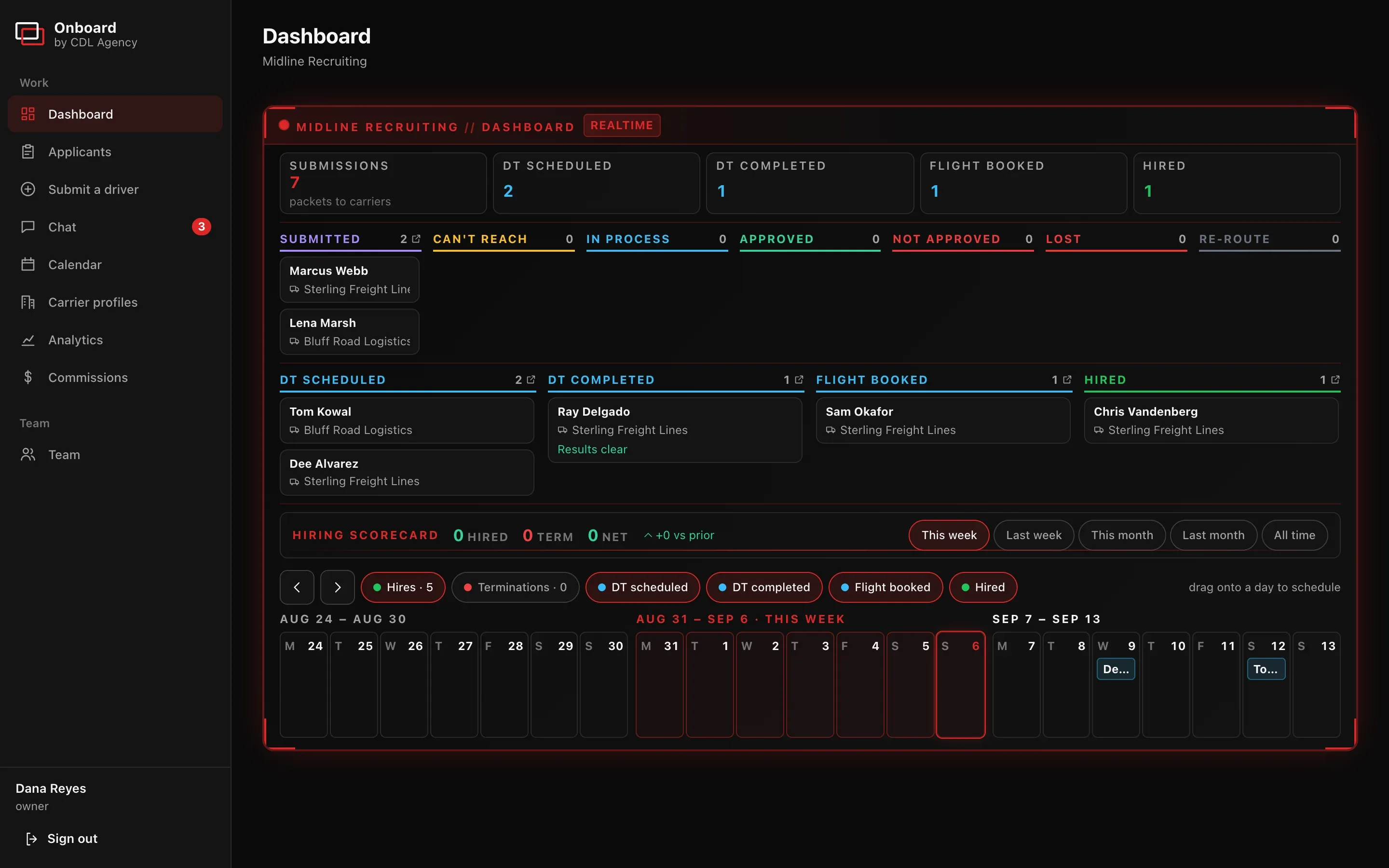
Onboard recruiter dashboard — demo data
Product screen · demonstration data

Driver placement platform for recruiting agencies and carriers

Onboard

Runs CDL Agency's driver submissions and partner agencies' placements.

Recruiters upload a driver's CDL, the application fills itself in, and a submission packet goes to the carrier. The carrier approves, declines or confirms the hire from a secure link, and every placement lands in a commission ledger that pays out by retention milestone.

  • AI reads the driver's CDL photo or PDF and fills in the application
  • Submission packets sent to carriers in one step
  • Carriers approve, decline or confirm a hire from a secure link — no login
  • Shared pipeline, calendar and carrier chat
  • Commission ledger with installments paid per retention milestone
  • Partner invitations with e-signed agreements
Explore Onboard

How we get there

An engineer in your corner.
A plan on your desk.

Start with a conversation
  1. 01

    Have the conversation

    Thirty minutes with you and a department lead. Show us the systems, the repetitive work and the questions you can’t answer.

  2. 02

    Get a written map

    We identify the bottlenecks, measure the baseline and put the opportunities in order. The map is yours to keep.

  3. 03

    Build it with your team

    An engineer works inside your existing tools. Your people review the workflow and test it before it takes action.

  4. 04

    Measure. Learn. Improve.

    We review the numbers together, train your team and decide what to tackle next. One useful workflow at a time.

Engagement

The memory is the first thing we build.

Every engagement starts here, because every other automation depends on it. We connect the systems you already pay for, import the history that matters and give your team one place to ask.

It runs on your own tenant, with your access rules. Your data is never used to train anything outside your company.

What a company memory actually is

It is not another dashboard and it is not a chatbot bolted onto a folder. It is a continuously synced copy of the records, documents and conversations your company produces, organized around the things that matter in trucking: drivers, trucks, loads, customers, incidents and money.

Each record keeps its history. A driver’s file shows the application, the recruiter’s calls, the orientation date, the safety events, the pay disputes and the exit interview, in order. When an AI agent acts on that driver, it acts with the whole story in front of it.

Why trucking companies need it more than most

Turnover is the reason. When a dispatcher or safety manager leaves, the relationships, the exceptions and the “we always do it this way for this customer” leave too. A memory that outlives the employee is the difference between a bad month and a bad quarter.

The second reason is audits. A DOT audit, an insurance renewal or a customer’s compliance questionnaire asks for evidence from months ago. When everything is indexed, the answer is a search, not a project.

FAQs

Company Memory questions?
Find answers.

Have more questions? Reach out or book the audit.

Anything with an API or a scheduled export: TMS platforms such as McLeod, TMW and Truckbase; ELDs such as Samsara and Motive; ATS tools such as Tenstreet; QuickBooks and payroll providers; Google Workspace and Microsoft 365 email; RingCentral, Dialpad, 3CX and other phone systems. We confirm each connection during the audit before promising it.

In a private database for your company, hosted by us or in your own cloud account. Access is by role, every query is logged, and your data is not used to train shared models.

No. Your TMS, ELD and accounting system stay the systems of record. The memory reads from them, links them together and writes back only where you approve it.

The first systems are usually connected within the first two weeks of the build. Historical email and documents take longer to import depending on volume, and we agree the cut-off date with you.

Only through an agent you approve. For example, a driver can text a question about pay and get an answer from the memory, without ever seeing anyone else’s record.

A good place to start

Let’s make room for the work that matters.

Bring the process that slows you down. We’ll map the opportunity, talk through what’s practical, and give you a clear next step.